Your Manual Operating Model Is Now Your Biggest Risk
Life sciences organizations are under pressure to move faster, reduce compliance cost, and strengthen inspection readiness — without proportional increases in headcount.
Meanwhile, AI capabilities are already embedded inside the platforms you own. The question isn't whether to adopt AI. It's whether you're activating what's already available — responsibly, defensibly, and at scale.
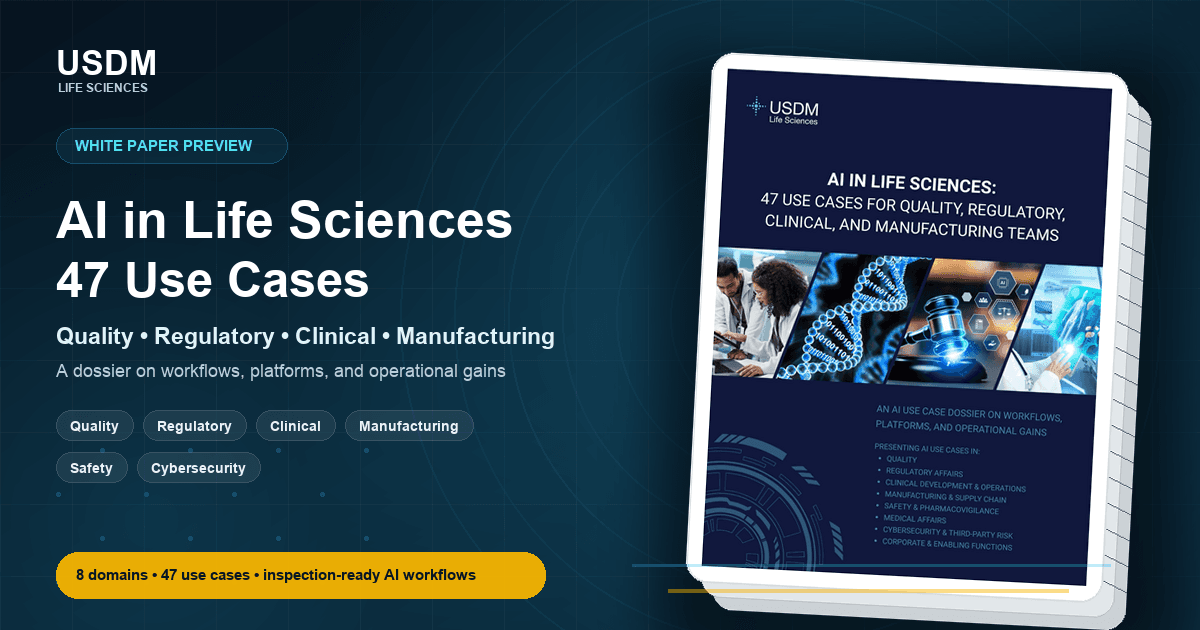
This white paper maps 47 concrete AI use cases across eight regulated domains, with quantified outcomes and inspection-aware architecture — so you can move from pilot to production with confidence.
What's Inside
- 47 use cases mapped across 8 regulated functional domains, from Quality and Regulatory to Cybersecurity and Corporate Functions.
- A Buy vs. Build vs. Augment framework for deciding when to activate platform-embedded AI versus invest in custom development.
- 6 deep dives — inspection readiness, batch record review by exception, TMF quality intelligence, labeling impact analysis, case processing, and MLR review.
- Inspection-ready architecture — multi-agent system designs with human-in-the-loop governance and full audit trails.
- An AI maturity progression for every use case — from assistive automation to generative reasoning to predictive intelligence — so you can phase adoption.
Regulatory agencies are no longer asking if you use AI. They're asking how you govern it. Organizations that move early — with defensible architecture and validated workflows — will set the standard. Those that wait will inherit someone else's framework. USDM's point of view is simple: AI in a regulated environment is only as valuable as it is defensible, which is why every use case in this dossier is paired with AI governance and compliance guardrails and an audit-ready architecture, not just an efficiency claim.
What's Inside
8 Domains · 47 Use Cases · 3 Maturity Levels
- Quality & Compliance — Deviation triage, CAPA root cause, audit prep, supplier qualification
- Regulatory Affairs — Submission readiness, labeling impact analysis, health authority intelligence
- Clinical Operations — TMF quality intelligence, CRO oversight, protocol deviation detection
- Manufacturing & Supply Chain — Batch record review by exception, predictive maintenance, supply disruption
- Safety & Pharmacovigilance — Case intake automation, narrative drafting, signal detection
- Medical Affairs — MLR acceleration, KOL mapping, medical information response
- Cybersecurity — Threat classification, GxP system monitoring, identity governance
- Corporate Functions — Contract analysis, knowledge management, onboarding acceleration
Each use case includes an AI maturity progression — from assistive automation to generative reasoning to predictive intelligence — so you can plan adoption in phases.
Who This Is For
- Quality & Compliance: CQOs, VPs of Quality managing deviations, CAPAs, and inspection readiness
- Regulatory Affairs: VPs of RA navigating submission complexity and labeling
- Clinical Operations: VPs of Clinical Ops overseeing TMF and CRO performance
- Manufacturing & Supply Chain: SVPs of Ops tackling batch review and supply disruption
- Safety & Pharmacovigilance: Heads of PV facing 8–12% annual case volume growth
- Medical Affairs: Leaders managing MLR cycles averaging 4–6 weeks with 30%+ rework
- CIOs, CTOs & Chief AI Officers: Evaluating AI through the lens of operational impact
The Numbers That Matter
| Domain | Impact |
|---|---|
| Quality | 30–50% faster deviation triage |
| Manufacturing | 50–80% reduction in batch record review |
| Safety & PV | 50–70% reduction in narrative drafting |
| Regulatory | 20–35% faster submission readiness |
| Medical Affairs | 25–35% reduction in MLR review cycle time |
| Clinical | 30–50% reduction in manual TMF QC |
Outcomes are based on USDM client engagements and domain benchmarks. The white paper includes detailed methodology and context for each figure.
Why USDM
USDM Life Sciences partners with regulated organizations to embed intelligent automation into existing enterprise platforms — reducing compliance cost, accelerating execution, and remaining defensible under inspection. Because these use cases run on validated GxP systems, the dossier pairs each AI workflow with the controls regulated teams already rely on — from computer software assurance (CSA) approaches to 21 CFR Part 11 expectations and data integrity in life sciences.
What You Get
- 47 use cases mapped across 8 regulated functional domains
- Buy vs. Build vs. Augment framework for evaluating platform-embedded AI vs. custom development
- 6 deep dives — inspection readiness, batch record review by exception, TMF quality intelligence, labeling impact analysis, case processing, and MLR review
- Inspection-ready architecture — multi-agent system designs with human-in-the-loop governance and full audit trails
Contributors: John Petrakis (Chief AI Officer), Hovsep Kirikian (VP Strategy & Operations), Mark Ohrvall (VP Delivery Operations), Lisa Om (VP Marketing & Communications), Brian Rankin (Head of Cybersecurity Services), Jennell Botero (Principal Consultant), Brittany Walker (Principal Consultant). Learn more about USDM leadership and experts on the people page.
FAQ: AI Use Cases in Life Sciences
How many AI use cases does this white paper cover?
The dossier maps 47 concrete AI use cases across eight regulated domains: Quality & Compliance, Regulatory Affairs, Clinical Operations, Manufacturing & Supply Chain, Safety & Pharmacovigilance, Medical Affairs, Cybersecurity, and Corporate Functions. Each use case is described with an AI maturity progression so teams can plan adoption in phases rather than all at once.
What does "inspection-ready" AI architecture mean?
It means AI workflows are designed to hold up under regulatory scrutiny — built as multi-agent systems with human-in-the-loop governance and full audit trails. In practice that ties directly to validated-system expectations such as 21 CFR Part 11, modern computer software assurance (CSA) thinking, and the broader discipline of AI governance and compliance.
Should we buy embedded AI, build custom, or augment what we already own?
The paper includes a Buy vs. Build vs. Augment framework to answer exactly this. Because so much AI capability is already embedded inside platforms life sciences organizations license today, the framework helps teams decide when activating embedded AI is enough and when custom development is justified — without compromising data integrity or governance.
Which roles benefit most from this dossier?
It is written for quality, regulatory, clinical, manufacturing, safety, and medical affairs leaders, as well as CIOs, CTOs, and Chief AI Officers who evaluate AI through the lens of operational impact. The six deep dives — inspection readiness, batch record review by exception, TMF quality intelligence, labeling impact analysis, case processing, and MLR review — give each function a concrete starting point.
How do the quantified outcomes apply to my organization?
The outcomes — such as 30–50% faster deviation triage or 50–80% less batch record review effort — are drawn from USDM client engagements and domain benchmarks, and the white paper documents the methodology and context for each figure. They are intended as planning ranges, not guarantees, and depend on your data, systems, and governance maturity. To pressure-test them against your environment, talk with a USDM expert.
Govern AI Before You Scale It
Activating AI inside regulated workflows raises real questions about oversight, third-party exposure, and security. The dossier's governance lens connects to USDM's work on third-party risk management and life sciences cybersecurity, so AI adoption strengthens your compliance posture instead of straining it.
Download the White Paper
Get all 47 use cases, the Buy vs. Build vs. Augment framework, six domain deep dives, and the inspection-ready architecture in one dossier. Complete the form to download your copy.
Have a specific use case in mind? Talk with a USDM expert to map it to your platforms, data, and governance requirements.
Watch the USDM Summit On-Demand
This white paper is part of a broader conversation on how life sciences organizations can move from AI intent to inspection-ready impact.
At the USDM Life Sciences Summit 2026, industry leaders, practitioners, and regulators explored these use cases in greater depth — sharing real-world lessons, architectural patterns, and governance approaches that work in regulated environments.
If this dossier resonates with your current challenges, the Summit is where strategy becomes execution. Watch on-demand now.