

The call comes in on a Tuesday morning. Your Phase 3 data is clean. The primary endpoint hit. The team breaks out into applause, Slack lights up, and leadership starts drafting the press release. Three days later, your regulatory lead walks into your office with a 47-item gap list. Your electronic systems were never formally validated. Your QMS hasn’t been audited in two years. Your submission infrastructure doesn’t exist. The GxP foundation that the FDA expects to see behind every NDA was quietly falling behind while your clinical team was winning. This is the moment that separates biotechs that file on schedule from those that delay by 12 to 18 months — or worse, receive a Complete Response Letter after submission.
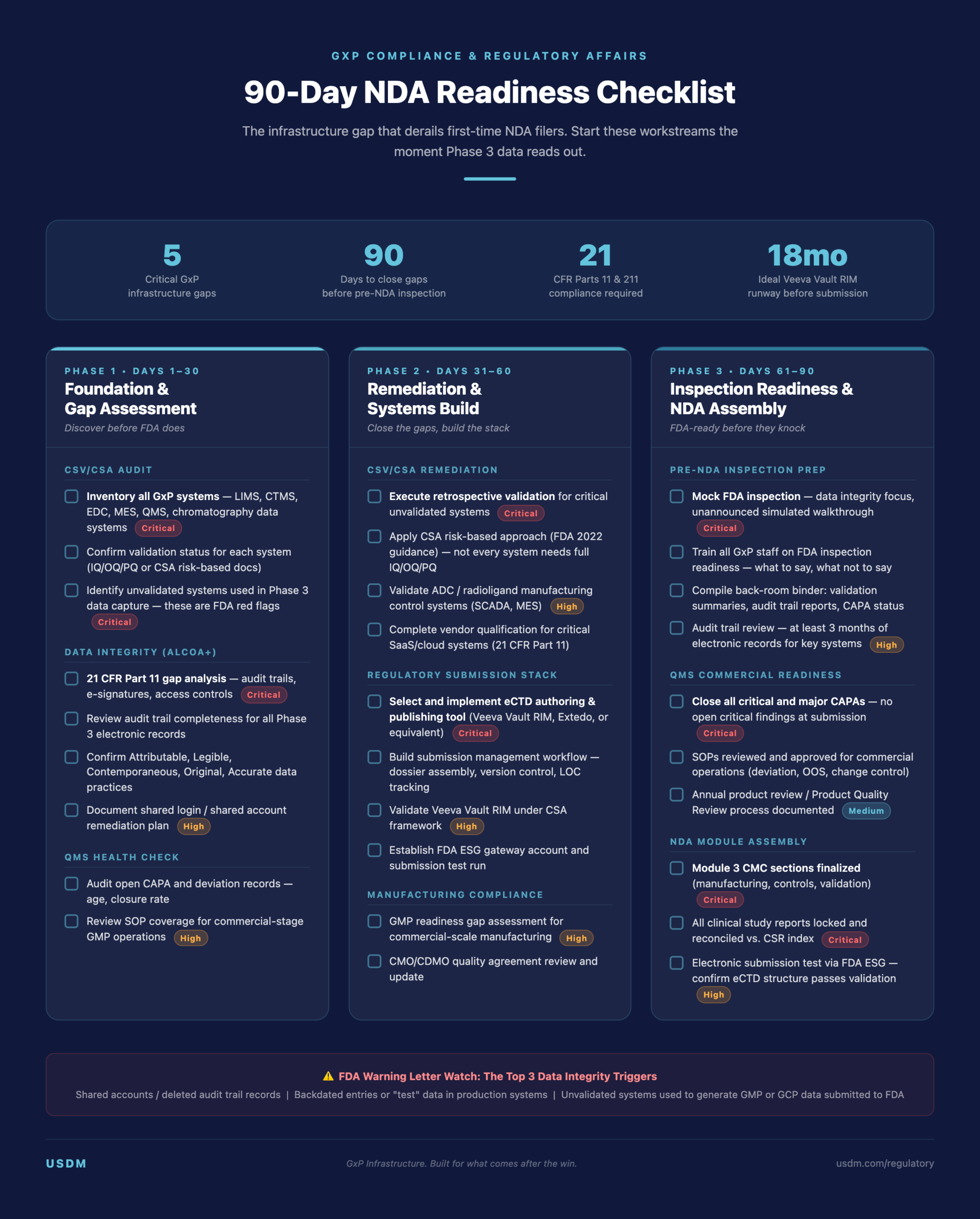
The distance between a Phase 3 win and a successful NDA submission is measured in infrastructure, not data. Most clinical-stage oncology biotechs have world-class science. Many have underdeveloped GxP systems, and they discover the gap at exactly the wrong time. There are five critical failure areas that surface repeatedly at the NDA readiness stage: Computer System Validation, Data Integrity, QMS Maturity, Regulatory Submission Infrastructure, and Manufacturing and Supply Chain Compliance. USDM’s GxP compliance services have helped clinical-stage biotechs navigate each of these gaps, and the companies that come out intact are the ones that started the infrastructure work before the Phase 3 readout, not after.
Watch: What most biotech teams get wrong in the 90 days after Phase 3
The NDA Readiness Gap Nobody Talks About
Clinical milestones generate celebration. GxP gaps generate warning letters. The two operate on completely different timelines, and most organizations treat them that way — clinical development runs on one track, regulatory and quality infrastructure runs on another, and they are expected to converge cleanly at the NDA filing date. They rarely do.
The FDA’s expectations for an NDA submission are not limited to the clinical data package. Reviewers and inspectors are evaluating the systems that generated, managed, and protected that data. Under 21 CFR Part 11, any electronic records and electronic signatures used in clinical data management must meet specific requirements for audit trails, access controls, system validation, and record retention. Under 21 CFR Part 211, current Good Manufacturing Practice regulations require that manufacturing systems, equipment, and controls meet the standards expected of a commercial operation — or at least demonstrate a credible pathway to commercial readiness.
The problem is structural. A Series B biotech running a Phase 2 oncology trial has very different GxP needs than that same company 24 months later preparing a 100,000-page NDA. The systems, SOPs, and quality infrastructure that were adequate for clinical-stage work often cannot withstand the level of scrutiny that accompanies a pre-NDA inspection. By the time the gap is visible, the runway is already short.
5 GxP Infrastructure Failures That Derail NDAs
1. Computer System Validation (CSV) Gaps
Every electronic system used to generate, collect, process, or store data that supports an NDA must be formally validated. This includes clinical data management systems, laboratory information management systems, electronic data capture platforms, manufacturing execution systems, and quality management systems. Validation means documented evidence that the system consistently does what it is supposed to do, and that the validation was performed in a controlled, traceable way.
The gap that appears most often is not a complete absence of validation — it is partial validation. A system was qualified when it was installed, but never re-validated after a major upgrade. Or validation was performed by the vendor, and the biotech accepted vendor documentation without assessing whether it met FDA expectations for their specific use. Or the system was informally validated — tested by the team, results documented in a shared drive folder — in a way that will not survive a reviewer’s scrutiny.
Under the FDA’s more recent Computer Software Assurance (CSA) guidance, the goal is to shift from exhaustive documentation toward risk-based testing and critical thinking. That is good news for teams building or remediating validation programs, but it does not eliminate the obligation. It redirects it. What FDA inspectors want to see is evidence that you thought carefully about risk, tested the things that matter most, and documented your reasoning clearly. Learn more about USDM’s CSV/CSA validation approach.
2. Data Integrity Failures
Data integrity failures are the leading cause of FDA warning letters in pharmaceutical manufacturing and clinical operations. The FDA’s 2018 Data Integrity and Compliance With Drug CGMP Guidance is explicit: data must be attributable, legible, contemporaneous, original, and accurate. These are the ALCOA principles, and they apply to every record that supports an NDA.
The most common failures are not malicious. They are systemic. Audit trails are disabled because a system administrator turned them off years ago and no one checked. Multiple users share login credentials because it was more convenient during a busy clinical period. Electronic records are exported to spreadsheets for analysis and the spreadsheets become the working record while the original data is forgotten. Raw data files are stored in locations with insufficient access controls.
Each of these creates a data integrity vulnerability. During a pre-NDA inspection, FDA investigators will request audit trail data, access logs, and system configuration records. They are specifically trained to look for gaps between what the system recorded and what the submission reflects. A single audit trail discrepancy can trigger a broader inspection that delays approval.
3. Quality Management System (QMS) Immaturity
A QMS designed for a 50-person clinical-stage company running a single trial is not the same as a QMS ready for commercial operations. The gap is not always in what the QMS contains — it is in whether the QMS is actually functioning at the level the NDA submission implies.
The specific failure areas are: SOP coverage that does not extend to all commercial-relevant processes; deviation management processes that are not consistently followed or documented; CAPA systems that identify problems but do not track effectiveness verification; change control processes that were not applied to system changes or manufacturing changes during the clinical period; and management review that is perfunctory rather than data-driven.
FDA expects to see a QMS that is mature, self-correcting, and embedded in how the organization operates. A QMS that exists on paper but is not actively used is a liability in an inspection, not an asset.
4. Regulatory Submission Infrastructure
Many clinical-stage biotechs arrive at the NDA filing decision without a validated eCTD publishing system, a document management system capable of supporting the submission lifecycle, or staff with direct experience managing an NDA. USDM’s regulatory submission services address this gap directly. This is a predictable gap — there was no business case for building commercial submission infrastructure before commercial success was confirmed — but it creates a serious scheduling problem.
Implementing a validated regulatory information management system such as Veeva Vault RIM takes 9 to 18 months when done properly. That includes system configuration, validation, user training, document migration, and the process work required to operate the system effectively. If you start that implementation after your Phase 3 readout, you are filing late. If you do not implement a validated system at all, you are filing on the regulatory equivalent of duct tape, and it will show.
5. Manufacturing & Supply Chain Compliance
NDA approval means commercial manufacturing approval. The FDA will not approve a drug if the manufacturing site cannot demonstrate GMP compliance at commercial scale. For many clinical-stage biotechs that have relied on CDMOs through clinical development, this means ensuring that the CDMO’s systems, batch records, validation packages, and quality agreements are at commercial readiness — and that the biotech has sufficient oversight to stand behind them in an inspection.
The specific gaps that appear at this stage include: process validation not completed or not adequately bridged from clinical to commercial scale; analytical method validation that was performed for clinical purposes but does not meet commercial release specifications; supplier qualification programs that are not documented to GMP standards; and quality agreements with CDMOs that are out of date or insufficient.
CSV and CSA in the ADC and Radioligand Era
Antibody-drug conjugates and radioligand therapies represent two of the fastest-growing categories in oncology development. They also represent some of the most complex manufacturing environments in pharmaceutical development — and the most demanding from a computer system validation perspective.
ADC manufacturing involves multi-step bioconjugation processes where system controls, in-process monitoring, and data integrity requirements are more complex than traditional biologics. The manufacturing execution systems and laboratory systems used in ADC production must be validated not just for general GMP compliance, but for the specific process parameters and safety controls relevant to cytotoxic payloads. Validation gaps in these systems can put both data integrity and operator safety at risk.
Radioligand therapy manufacturing operates under additional regulatory frameworks that intersect GMP and radiation safety requirements. The electronic systems managing radiopharmaceutical batch release, dose calibration, and chain of custody face validation requirements from multiple regulatory bodies simultaneously.
ICH Q10, the Pharmaceutical Quality System guideline, provides the overarching framework for how manufacturing quality systems should operate across the product lifecycle. For ADC and RLT programs, ICH Q10 implementation means building quality system infrastructure that can manage the handoffs between biological, chemical, and in some cases radiological manufacturing steps. USP General Chapter <1058>, Analytical Instrument Qualification, provides specific guidance for qualification of the analytical instruments that are integral to these manufacturing processes.
For teams running ADC or RLT programs toward NDA, the CSV/CSA validation scope needs to be assessed early, because the remediation timeline for complex manufacturing systems is longer than for standard pharmaceutical applications.
Building Your Data Integrity Framework Before the FDA Reviewer Arrives
The FDA’s 2018 Data Integrity Guidance describes ALCOA+ as the standard against which electronic records will be evaluated. ALCOA+ extends the original five attributes — attributable, legible, contemporaneous, original, accurate — to add complete, consistent, enduring, and available. Every record that supports your NDA needs to meet this standard.
Building a data integrity framework is not a documentation exercise. It is a technical and operational exercise. The specific steps that matter most are:
Audit trail configuration and review. Every GxP system should have audit trails enabled, and those audit trails should be routinely reviewed as part of the quality oversight process. If audit trails were disabled at any point, that needs to be disclosed, investigated, and remediated. Discovering audit trail gaps during a pre-NDA inspection is a material finding.
Access control remediation. Shared credentials must be eliminated. Every user with access to a GxP system must have a unique, authenticated identity. Access levels should be role-based and documented. Inactive user accounts should be disabled through a formal process.
Electronic record migration and validation. If historical data exists in legacy systems or unvalidated environments, a migration plan with appropriate validation and data verification is required before that data can be cited in an NDA.
Pre-NDA inspection simulation. Before FDA arrives for a pre-approval inspection, your team should conduct an internal audit specifically focused on data integrity: pulling audit trail records, verifying access logs, checking system configurations, and validating that the electronic records match the paper trail in your submission. The gaps that inspectors find are almost always the gaps that an internal team would find if they looked in the same places.
Sequencing Your Regulatory Submission Systems
The decision to implement Veeva Vault RIM — or an equivalent validated regulatory information management system — is a sequencing decision as much as a technical one. USDM’s Veeva Vault implementation practice helps clinical-stage biotechs navigate this decision. The question is not whether to implement it. The question is when, and what the consequences are of getting the timing wrong.
USDM’s recommendation for companies in the Phase 2 to Phase 3 transition is to begin the implementation decision process no later than Phase 2 end-of-study, and to begin the actual implementation at Phase 3 initiation. That creates an 18 to 24-month runway before the anticipated NDA filing date — which is the minimum required for a proper implementation, validation, user training, and document migration effort.
For companies that are already in Phase 3 with no submission system in place, the options narrow quickly. A compressed implementation timeline is possible, but it requires dedicated resources, experienced implementation partners, and aggressive governance. Cutting corners on validation to hit a timeline is not a viable option — it creates exactly the type of documented gap that a pre-NDA inspection will surface.
The specific capabilities that a validated regulatory submission system must support include: eCTD publishing and submission tracking; document lifecycle management with version control and audit trails; regulatory intelligence and dossier management; and correspondence management with FDA. Systems that cannot demonstrate validated, auditable performance across these functions are not submission-ready, regardless of how functional they appear in a demonstration.
At the Phase 3 to NDA transition, the submission system infrastructure needs to be stable, validated, and actively in use — not being implemented in parallel with the filing effort.
FAQ
What does GxP readiness mean for an NDA submission?
GxP readiness means that the systems, processes, and documentation supporting your NDA can withstand a pre-approval inspection by the FDA. This includes validated electronic systems, a functioning quality management system, data integrity controls that meet ALCOA+ standards, manufacturing processes validated to commercial scale, and a submission infrastructure capable of producing a compliant eCTD package. GxP readiness is not a checklist — it is an operational state. The FDA evaluates whether your quality systems are actually working, not just whether they exist on paper.
When should a clinical-stage biotech start CSV/CSA work?
The formal answer is that computer systems used in GxP activities should be validated at the time of implementation and maintained in a validated state throughout their use. The practical answer for a clinical-stage biotech preparing for an NDA is that any remediation of existing validation gaps should begin no later than 24 months before anticipated filing. Systems used in Phase 3 clinical data management, manufacturing, and quality operations will all be in scope for a pre-NDA inspection. If those systems have validation gaps, the remediation timeline needs to be built into the NDA readiness plan explicitly, not addressed reactively.
What is ALCOA+ and why does it matter for data integrity?
ALCOA+ is the FDA’s standard for evaluating the quality of electronic records. The original ALCOA acronym stands for attributable, legible, contemporaneous, original, and accurate. The plus adds complete, consistent, enduring, and available. These attributes describe what a trustworthy record looks like: it is clear who created it and when, the information is correct and unaltered, the record is complete, and it can be retrieved and reviewed at any point during the record retention period. Data integrity failures — audit trail gaps, shared credentials, altered records — are evaluated against this standard. A record that cannot meet ALCOA+ requirements cannot reliably support an NDA submission.
How long does it take to implement a Veeva Vault RIM system?
A properly implemented Veeva Vault RIM deployment — including system configuration, validation, data migration, user training, and SOP development — typically takes 12 to 18 months for a clinical-stage biotech with moderate submission history. More complex implementations, including data migration from legacy systems or multi-regional regulatory management, can extend that timeline. Companies that attempt to compress Veeva Vault RIM implementations into 6 months or less typically produce validation packages and operating procedures that are not audit-ready. The implementation needs to be treated as a capital project with dedicated resources, formal project governance, and a validation master plan — not as an IT deployment.
What are the most common FDA warning letters related to data integrity?
The most frequently cited data integrity violations in FDA warning letters include: audit trails that were disabled, not enabled, or not routinely reviewed; employees sharing login credentials or using generic accounts; data deleted or overwritten without adequate controls or documentation; test results recorded on unofficial worksheets before transcription to official records; analytical reinjections performed without investigation or documentation; and lack of access controls allowing unauthorized modification of electronic records. These findings appear across manufacturing sites, clinical laboratories, and contract organizations. They share a common root cause: quality systems that did not treat electronic data with the same rigor as paper records. The FDA’s 2018 Data Integrity Guidance addresses all of these failure modes directly.
USDM helps clinical-stage biotechs build the GxP infrastructure that survives FDA scrutiny. Contact our regulatory team to assess your NDA readiness gap.