Life sciences organizations know what AI can do. What most don’t yet have is the infrastructure to do it safely, repeatably, and in a way that survives regulatory scrutiny.
In this comprehensive white paper, USDM’s AI Center of Excellence lays out the operational framework to close that gap — covering the AI system lifecycle, partner platform risks, vendor assessment, citizen development, and how to get started in 90 days.
For teams searching for an enterprise AI governance framework for life sciences, the paper connects GxP AI governance, AI compliance, AI validation, EU AI Act readiness, FDA Computer Software Assurance, ISO 42001-aligned management practices, and partner AI oversight into one practical operating model.
What’s Inside
- The AI system lifecycle — a six-stage, governance-integrated framework spanning ideation through decommissioning.
- Partner AI as a compliance blind spot — what happens when platforms activate AI inside validated GxP environments without your action.
- AI vendor assessment & third-party risk management — why TPRM must now include AI, assessed across six dimensions.
- The citizen development frontier — enabling business-led AI development inside GxP guardrails.
- A 90-day pathway — three entry points to establish a governance baseline fast.
AI governance for life sciences: the enterprise framework this white paper helps you build
This AI governance for life sciences white paper is built for organizations that need an enterprise AI governance framework, not a generic policy. It shows how to govern AI across the lifecycle: intake, intended use, risk classification, validation planning, deployment, monitoring, change control, and decommissioning.
The result is a repeatable model for compliant, scalable AI adoption in pharma, biotech, medical device, and broader regulated life sciences environments — one that gives Quality, Regulatory, IT, Data, Cybersecurity, and executive teams a shared language for deciding which AI use cases can move, which need stronger controls, and what evidence must be retained.
The framework is especially relevant for regulated teams managing AI in GxP environments, partner platforms, vendor tools, citizen development, and emerging agentic workflows. It helps leaders connect AI compliance, AI validation, data integrity, cybersecurity, and third-party risk into one operating model.
Why GxP AI governance matters now
- The EU AI Act’s high-risk enforcement provisions take effect August 2026 — requiring conformity assessments, technical documentation, and continuous monitoring.
- Partner platforms including Veeva, Box, and ServiceNow are embedding AI directly into validated GxP environments, often without explicit customer action.
- Board-level pressure to reduce compliance costs 15–25% while simultaneously accelerating digital transformation.
Organizations that build unified AI governance infrastructure gain a compounding advantage. Those that don’t face a new category of regulatory exposure that will only become clearer as FDA and EU enforcement guidance matures.
Key Stats from the Paper
Who needs an AI governance framework for life sciences?
- Quality and Regulatory Affairs leaders managing AI adoption in GxP environments
- CIOs and CTOs responsible for validated platform governance
- Chief AI Officers and Digital Transformation leaders building scalable AI programs
- Compliance and Validation teams navigating FDA, EU AI Act, and ISO 42001 simultaneously
Frequently Asked Questions
FAQ: AI Governance for Life Sciences White Paper
Who should download this AI governance for life sciences white paper?
Quality, Regulatory, IT, Digital, Data, Cybersecurity, Validation, and executive leaders should download it when AI is moving from pilots into governed workflows. The white paper is designed for teams that need lifecycle controls, vendor oversight, GxP guardrails, and evidence that can stand up to audit or inspection.
What is AI governance in a life sciences context?
AI governance is the operational infrastructure for adopting AI safely, repeatably, and in a way that survives regulatory scrutiny in a regulated environment. This white paper frames it as an AI system lifecycle — a six-stage, governance-integrated framework that runs from ideation through decommissioning — rather than a one-time pilot approval. It connects directly to existing data integrity and Computer Software Assurance practices already familiar to GxP teams.
Why is “partner AI” treated as a compliance blind spot?
Partner platforms — including Veeva, Box, ServiceNow, and Microsoft — are embedding AI directly into validated GxP environments, often without explicit customer action. That means AI capabilities can become active inside a system you already validated, before your quality and validation teams have assessed them. The paper dedicates a chapter to this blind spot and to the third-party risk management needed to stay ahead of it.
How does third-party risk management change when AI is involved?
The white paper argues that TPRM must now explicitly include AI, and it lays out how to assess vendors across six dimensions. The goal is to extend the assessment discipline you already apply to software and service providers so that AI-enabled vendor capabilities are evaluated with the same rigor as the rest of your validated stack.
What is citizen development, and how do you keep it compliant?
Citizen development is business-led AI development — teams outside of formal IT building their own AI-enabled solutions. The paper covers how to enable that frontier inside GxP guardrails so business velocity does not come at the expense of validation, control, and auditability.
How does this framework support EU AI Act, FDA CSA, and ISO 42001 readiness?
The framework gives teams a practical way to connect AI risk classification, lifecycle controls, human oversight, vendor AI assessment, and documented evidence to the regulatory and management-system expectations emerging across the EU AI Act, FDA Computer Software Assurance, GAMP 5, and ISO 42001-aligned AI governance programs.
What does the 90-day pathway involve?
The closing chapter outlines three entry points to establish a governance baseline fast — from AI Maturity Assessments through AI-Governance-as-a-Service (AIGaaS) — so organizations can move from scattered pilots to a unified, inspection-ready governance foundation in about 90 days.
Operationalizing compliant AI adoption with USDM
The framework in this paper connects to the controls life sciences teams already run. AI systems still depend on trustworthy data, so data integrity remains foundational, and validated AI features should be assured using Computer Software Assurance (CSA) rather than treated as ungoverned tooling. As AI expands the attack surface and the vendor footprint, cybersecurity for life sciences and a continuously monitored compliance posture through USDM Cloud Assurance become part of the same governance fabric. For organizations ready to put governed AI to work, USDM’s agentic team shows what compliant, agentic AI looks like in practice.
Want Proof That AI Works in Regulated Environments?
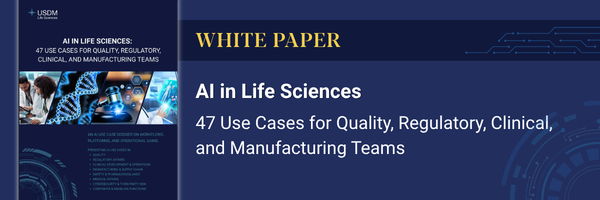
Want proof that AI works in regulated environments? Download USDM’s AI in Life Sciences: 47 Use Cases for Quality, Regulatory, Clinical, and Manufacturing Teams — with quantified outcomes and inspection-ready architecture to help you move from pilot to production with confidence.
Contributors
- John Petrakis, Chief AI Officer
- David Blewitt, VP of Digital Trust and AI Governance
- Enric Cullell, AI Quality Lead
- Elena Mirón, AI Program Manager
- Lisa Om, VP Marketing & Communications